

Most veterinary practices approach client acquisition the same way: run Google Ads, update the website, post on social media, and hope for the best. They get results like more traffic, more calls, more people walking through the door. But they’re not getting the results they actually need: more of the right clients who will become valuable, long-term relationships. If your phone is ringing constantly but your schedule isn’t filling with ideal clients, you don’t have a marketing problem. You have a differentiation problem. This guide will show you how to attract new clients for your veterinary practice—specifically, the clients who will help your practice grow sustainably.
Understanding the Real Client Acquisition Challenge
The veterinary industry is experiencing a downward trend in patient visits and new client acquisition across the country. Yet some practices are bucking this trend entirely.
Case Study: Valley Center Veterinary Clinic
A single-doctor, semi-rural practice achieved:
-
40% revenue growth
-
26% increase in new clients
-
7% increase in patient visits
—all compared to pre-COVID benchmarks.
Their secret: They stopped trying to attract everyone and started attracting the people who actually wanted what they uniquely offered.
Most practices face the same issue: attracting attention, but not the right attention. The solution isn’t more marketing. It’s clear positioning—marketing that pre-qualifies prospects so only good-fit clients pick up the phone.
Why Traditional Veterinary Marketing Fails to Attract Quality Clients
Traditional marketing treats all pet owners the same. It uses broad targeting, generic messaging, and commodity positioning. That used to work, but it doesn’t anymore. Modern pet owners research extensively before choosing a veterinarian. They read websites, compare reviews, and check social media. They have options—and they know it.
Generic marketing fails because it doesn’t differentiate. The practices winning today are those with the clearest positioning and most targeted approach.
Step 1: Define Your Ideal Client Profile (Not Just “Pet Owners”)
Before you can attract ideal clients, you have to define them.
How to Identify Your Ideal Client
-
Look at your best existing relationships—not just your biggest spenders.
-
List 10–15 of these clients and identify patterns across:
-
Demographics: age, income, family situation, location
-
Psychographics: values, pet parenting style, decision-making
-
Behavior: how they found you, what they use, what they praise
-
Create Your Ideal Client Statement
Use this template:
“We are the practice for [specific type of pet owner] who values [specific thing] and needs [specific outcome].”
Example:
“We are the practice for busy professionals with senior pets who value efficiency and expertise and need a veterinary team that manages complex chronic conditions without wasting their time.”
This becomes your North Star for all marketing and growth efforts.
Step 2: Identify What Makes Your Practice Genuinely Different
Most practices use interchangeable phrases: “Compassionate care.” “State-of-the-art facility.” “Experienced team.” “Treat your pet like family.”
Pet owners see these everywhere—they’re invisible.
Find Your True Differentiators
Ask yourself:
-
What type of cases do we handle most confidently?
-
What do clients consistently praise?
-
What would they miss most if they switched?
-
What do we invest in more than competitors?
Valley Center discovered their differentiator was relationship-driven care—an elevated medical standard paired with deep human connection.
Examples of Differentiators
-
Clinical focus: Fear-free handling, urgent care, geriatrics
-
Appointment style: Educational, efficient, participatory
-
Philosophy: Preventive, relationship-based, evidence-driven
-
Client experience: Transparent pricing, flexible scheduling
Pick one or two and own them completely.
Step 3: Rebuild Your Website to Attract Ideal Clients
Your website is where first impressions form. It must clearly answer: “Are you the right veterinarian for me?”
Rewrite Your Homepage
Generic example:
“We provide compassionate care for dogs and cats.”
Specific example (education-focused):
“You stayed up late researching your dog’s symptoms. We built this practice for people like you—engaged, curious, invested in understanding what’s happening with your pet.”
Include These Key Elements
-
Clear positioning statement
-
Recognizable client scenarios
-
Philosophy and approach
-
Testimonials from similar clients
-
Clear next steps
Consider Transparent Pricing
Clients expect it. The pricing page our team created for Valley Center improved trust and conversion immediately. Display typical fees and ranges—and explain the value behind them.
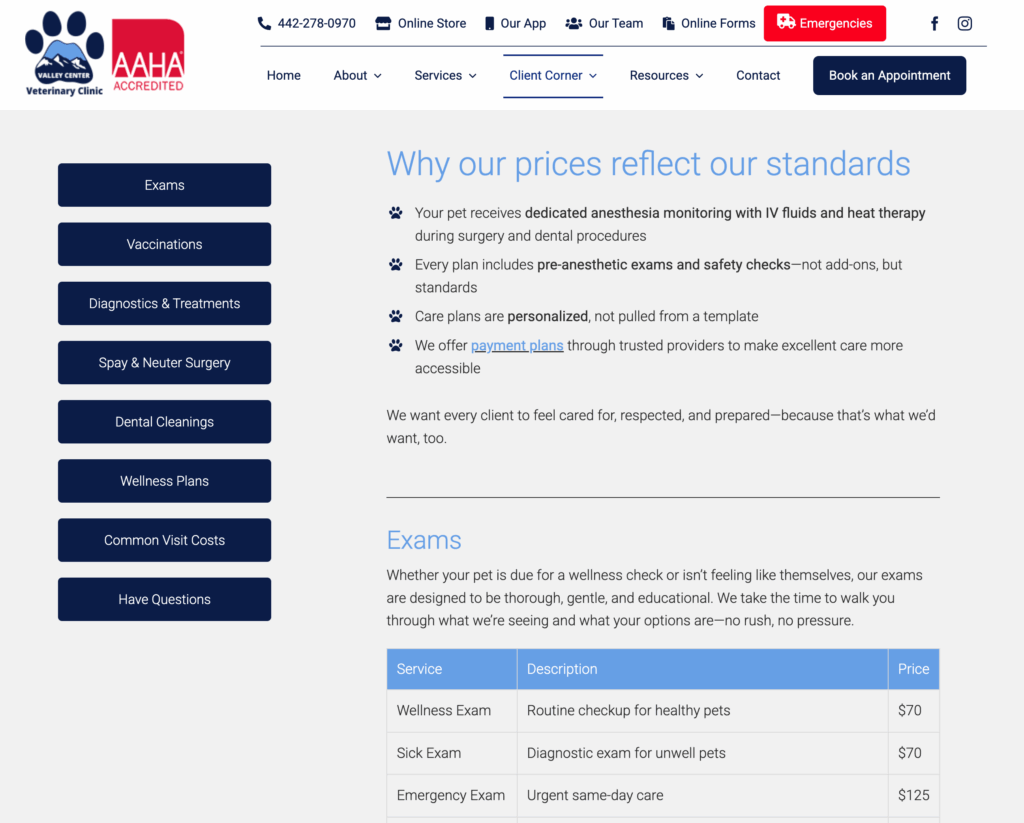
VCVC Pricing Page written & built by Digital Empathy
Step 4: Optimize Google Ads for Qualified Traffic, Not Volume
Don’t aim for clicks. Aim for conversions.
Generic ad:
“Experienced vet in [city]. Accepting new clients.”
Specific ad:
“Fear-free vet care for anxious dogs in [city]. Certified low-stress handling. Book online.”
Case Study Metrics (Valley Center)
-
Cost per click: $3.22
-
Conversion rate: 34.9%
-
Cost per call: $9.23
Track and optimize based on conversion rate and call quality, not total clicks.
Step 5: Build SEO Through Strategic Content Creation
SEO isn’t about ranking for “veterinarian [city].”
It’s about ranking for your ideal clients’ actual questions.
Example Topics
Preventive Care:
-
“How often should dogs see the vet?”
-
“What’s included in a wellness exam?”
Fear-Free Care:
-
“Signs your dog has vet anxiety”
-
“How to prepare anxious dogs for vet visits”
Senior Care:
-
“Managing arthritis in dogs”
-
“When to consider hospice care”
Write from your unique perspective. Share stories, explain your approach, and show expertise.
Publish consistently (2–4 posts/month). Google rewards experience and trust.
Step 6: Leverage Your Best Clients for Referrals
Your happiest clients are your best marketing channel.
Make Referrals Easy
-
Ask directly: “We love clients like you—if you know someone similar, here’s a card.”
-
Offer incentives: e.g., “Refer a friend, get $25 off.”
-
Create shareable content: Stories clients want to share.
-
Thank referrers: A handwritten note goes a long way.
Track who drives referrals and recognize your top promoters.
Step 7: Track Metrics That Actually Matter
Forget vanity metrics like traffic or followers. Track what drives profitable growth.
-
CAC (Customer Acquisition Cost) = spend ÷ new clients
-
Conversion rate by source = conversions ÷ leads
-
LTV (Lifetime Value) = average 2–3 year revenue per client
-
ROAS (Return on Ad Spend) = (LTV × new clients) ÷ spend
-
ACT (Average Client Transaction) = total revenue ÷ visits
Valley Center increased ACT by 32% after attracting better-fit clients.
Step 8: Optimize and Scale What Works
After 3–6 months, double down on what performs best:
-
Scale your top channels
-
Cut low-performing ones
-
Test one variable at a time (homepage copy, ad language, referral incentives)
Growth becomes data-driven, not guesswork.
Real Results: What Strategic Client Acquisition Looks Like
Valley Center combined:
-
Custom website and messaging
-
Four SEO blog posts per month
-
$800 Google Ads budget
-
Social media presence
-
Call tracking
Results:
-
+40% revenue
-
+26% new clients
-
+32% ACT
-
+7% patient visits
“Having a strategic partner takes a huge burden off my shoulders. I trust them implicitly.”
—Practice Manager, Valley Center Veterinary Clinic
Common Mistakes That Sabotage Growth
-
Treating all clients the same
-
Competing on price
-
Using generic positioning
-
Optimizing for volume over quality
-
Tracking vanity metrics
-
Trying to be everything to everyone
-
Ignoring who you’re naturally built to serve
Your 30-Day Action Plan to Start Attracting Better Clients
Week 1: Get Clear on Positioning
-
Identify your top 20 clients
-
Define your ideal profile
-
Write your positioning statement
Week 2: Update Your Website
-
Rewrite homepage and About page
-
Add pricing transparency
-
Simplify calls-to-action
Week 3: Optimize Paid Advertising
-
Audit keywords
-
Pause low-quality traffic
-
Rewrite ads for prequalification
Week 4: Start Content Creation
-
Identify top 10 client questions
-
Publish and share your first blog post
Working With a Strategic Growth Partner
You can implement these strategies yourself—or work with experts who live and breathe veterinary growth.
Why Practices Choose Digital Empathy
-
Exclusive focus on veterinary practices
-
Deep discovery process (no templates)
-
Content created by veterinary communication experts
-
Transparent Google Ads management
-
Data-driven consumer research
-
Proven results with independent practices
“Having a strategic partner helped us grow even during uncertain times.”
—Valley Center Veterinary Clinic
Visit digitalempathyvet.com to explore case studies and learn how we can help your practice grow with clarity and precision.
The Fundamental Shift for Sustainable Growth
The future of client acquisition isn’t about more—it’s about better.
Stop chasing volume. Start pursuing precision.
When you know who you’re for—and have the courage to say it—everything changes:
-
Marketing efficiency improves
-
Conversion rates rise
-
Team morale increases
-
Profitability grows
The practices that thrive aren’t the loudest—they’re the clearest. Stop trying to attract everyone. Start attracting the right ones.





Leave A Comment