
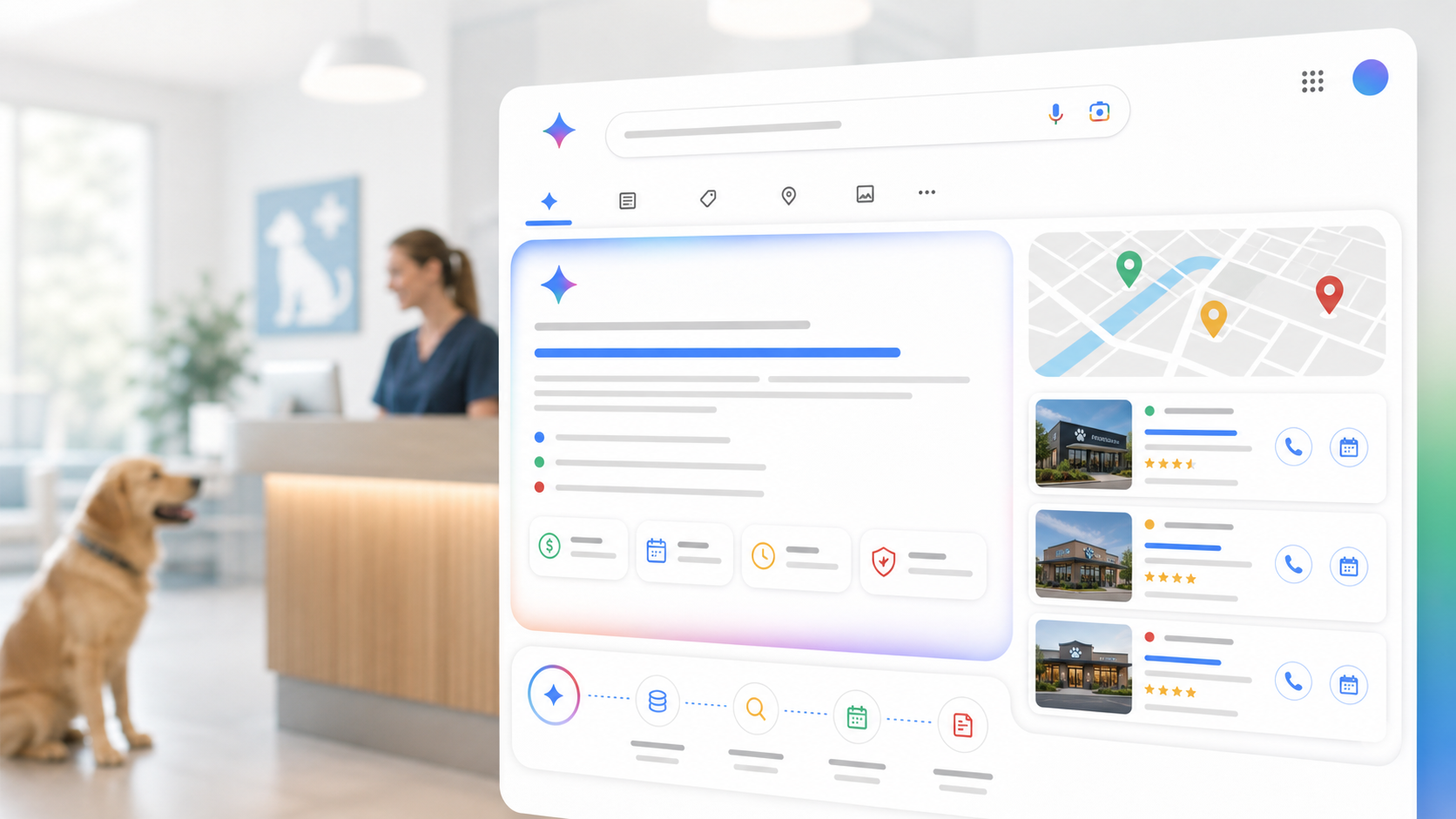
Most practice owners still picture Google Search the old way: someone opens Google, types a few words into the search bar, scrolls through the results, clicks a website, and decides what to do next. Google is moving people away from that pattern.
Last week, we wrote that a pet owner might choose a veterinary practice without ever opening that practice’s website. A few days later, Google held its annual product conference and announced new Search features that make that scenario much more realistic. People can now ask longer questions, continue conversations inside Search, and use AI agents to gather information from businesses.
Sarah Perez at TechCrunch described the change: “‘searching the web’ will increasingly be performed by AI agents.”
That means pet owners may not sort through search results themselves. They may ask Google to compare practices, summarize the options, check availability, and help them decide who to contact.
What Google Announced
At its annual product conference, Google introduced new Search features that let users ask longer questions, continue conversations inside Search, and send AI agents to gather information from businesses.
One part of the announcement applies directly to local service businesses. Google said users will be able to ask Google to call businesses on their behalf in select categories, including “home repair, beauty or pet care.” Google did not name veterinary hospitals specifically. But pet care sits close enough to veterinary medicine that practice owners should read the announcement carefully.
A pet owner looking for a new veterinarian may not call five hospitals to ask about pricing, availability, same-day appointments, or species treated. They may ask Google to compare local options and gather those answers for them. That puts routine front-desk questions into a new channel. Do you take new clients? Do you see same-day cases? What does an exam cost? Do you treat cats? How soon can I get in? Can I book online?
If Google cannot find those answers on a practice’s website, an AI agent may try to get them another way.
Have You Been Getting Robocalls to Your Practice?
If your team has started getting strange calls asking about pricing, appointment availability, services, or whether you’re accepting new clients, you’re not imagining it.
Practice managers and front-desk teams have been talking about these calls because they feel different from normal client calls. The caller may sound automated. The questions may sound oddly specific. The person, or system, on the other end may ask for the exact information a pet owner would need before choosing a hospital. Google is now building that behavior into Search. When a pet owner asks Google to compare exam fees at nearby veterinary practices, find an urgent care appointment, or check which hospital can see a sick pet today, Google needs answers. If Google can’t find those answers online, it may try to call your practice to get them.
Practice owners have a choice here. They can keep forcing every pricing, availability, and service question through the front desk, or they can publish the answers they’re comfortable sharing in places pet owners and AI systems can find them.
Put the basics where Google can read them before a robot calls your practice to ask.
What Information Should Be on My Veterinary Website?
Google’s Search team said users will be able to give Search specific criteria and let Google bring together pricing, availability, and booking options. For veterinary practices, that means owners should make the most common decision-making information easy to find before Google has to go looking for it somewhere else.
Start with the questions your front desk already answers every week:
- Are you accepting new clients?
- Do you offer same-day or urgent care appointments?
- What pets do you treat?
- What does a standard exam cost?
- What does an urgent care exam cost?
- How do pet owners book or request an appointment?
- What should a new client expect before the first visit?
Google’s Search Central guidance doesn’t tell practice owners to chase special AI tricks. Google tells website owners to keep pages crawlable, maintain clear business details, use Google Business Profiles, and create helpful content based on real experience.
That’s the work veterinary practices need to do now. Give pet owners and AI agents the same clear answers, in places they can actually find them.
How Digital Empathy Helps Veterinary Practices Market and Create Websites in the Age of AI
Our team wrote about AI search last week because we’ve been watching how pet owners, search engines, and AI tools interact with veterinary websites.
Google’s announcement makes that work more urgent. We already help practices publish clear service information, location details, provider expertise, FAQs, Google Business Profile content, and booking paths. Now we’re reviewing those same pieces through another lens: can an AI agent understand this practice well enough to recommend it?
We’re also testing how AI tools read veterinary websites, where they miss important context, and which signals they seem to trust. We don’t think practice owners should chase every new AI tactic. We do think they should work with a team that’s tracking how Google, ChatGPT, Gemini, Claude, and other tools are changing the way pet owners choose care.
We’ll keep sharing what we learn as Google releases more of these features. For now, practice owners should make sure their websites answer the questions pet owners already ask before they book.
What Veterinary Practice Owners Should Do Next
Practice owners don’t need to rebuild their entire website every time Google releases a new AI feature. They do need to make sure pet owners and AI systems can find accurate answers.
Start here:
- Ask your front desk for the 10 questions they answer most often before a pet owner books. Go through your website and see whether you answer those questions clearly. If you don’t, add those answers.
- Ask ChatGPT, Gemini, and Google AI Mode for veterinary hospital recommendations in your area. Try prompts a real pet owner would use, like “best vet for anxious dogs near me” or “urgent care vet open today in [city].” Write down which hospitals get mentioned, what the tools say about them, and whether your practice appears.
- Compare those AI answers against your competitors’ websites. If another hospital gets mentioned because they publish clearer pricing, urgent care details, doctor information, or booking instructions, treat that as a content gap.
- Look up your own Google Business Profile and confirm your hours, phone number, services, appointment link, photos, and business categories. If anything is outdated or vague, update it.
- Review your service pages and make sure pet owners can tell what you offer, what pets you treat, and when they should call you. If a service page could apply to any practice in the country, rewrite it with details from your hospital.
- Decide what pricing information your team is comfortable publishing. If your front desk gives the same exam fee, urgent care fee, or price range every day, consider putting that information online.
- Walk through your booking process like a new client. If you have to hunt for the appointment button, phone number, or request form, make the next step easier to find.
- Check whether pet owners can find real trust signals on your site: doctor names, team expertise, photos, reviews, and what kind of client your practice is best suited to help. If those details are missing, add them.
This is the work that helps your practice show up accurately when pet owners let AI tools do the searching for them.
Google’s Search Team Is Rewriting the Rules of Veterinary SEO
Google’s Search team has shown where Search is heading. They want users to ask longer questions, continue more of the conversation inside Google, and let AI tools gather information from businesses. Practice owners can’t treat SEO as ranking for “vet near me” anymore. They need to help Google understand their services, pricing, availability, team, location, booking options, and fit for a specific pet owner. Google also named pet care as a category where users may ask Google to call businesses for them. If pet owners let Google do more of the searching, comparing, and calling, practices need to give Google better information before an AI agent comes looking for it.
Digital Empathy is building websites and marketing strategies for this next version of search. Pet owners still need trust. Google may decide what they see before they ever land on your homepage.
If you’d like support reviewing the state of your independent practice, schedule a free 30-minute call with our Founder & CEO, Robert Sanchez. He’ll walk through what you’re seeing, share trends from other practices across the country, and offer practical, personalized suggestions for where to focus next. Or, if you’re not quite ready for a call, subscribe to our newsletter to stay up-to-date on other advice for your independent veterinary practice (the link is at the bottom of this page).


Leave A Comment