
How a new pet owner finds a vet in 2026
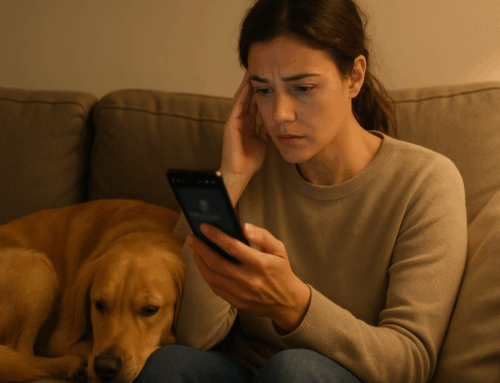
Picture a first-time dog owner. They just brought home a rescue. They want to find a vet. They don’t open Google. They open ChatGPT (or Claude, or Perplexity, or Gemini) and ask, “What are the best-rated vets in my city for a nervous rescue dog?”
The AI comes back with three names, addresses, star ratings, and a one-line reason for each pick. It flags which of the practices are Fear Free certified. It coaches the pet owner on what to ask when they call: happy visits, exam room flow, pre-visit medication for anxious dogs. It even names which of the three to start with, based on which had the most reviews specifically mentioning anxious-dog handling. The result? The pet owner picks one. They book their appointment without ever loading your practice website.
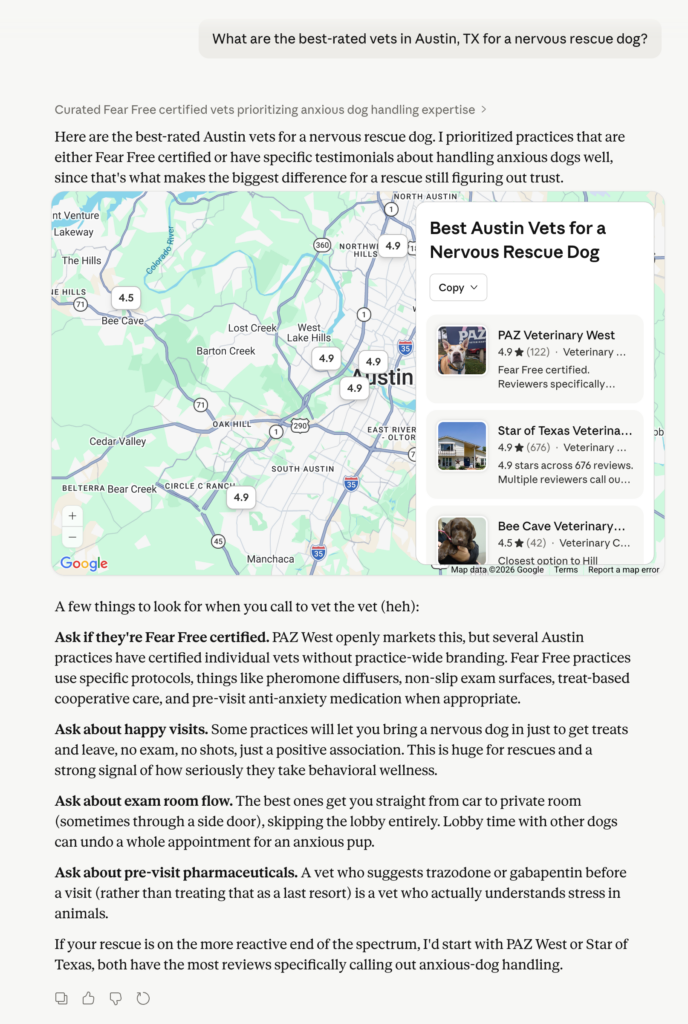
We plugged in this question to Claude. Here’s what it returned for the results (including Digital Empathy Client Star of Texas Veterinary Hospital!).
This is happening more every year. The most recent consumer survey on local-business search put AI use at 45% in 2026, up from 6% in 2025—that’s seven times as many people in twelve months. ChatGPT alone now sees more than 2.5 billion prompts per day.
We’re seeing the same shift inside Digital Empathy. Across the hundreds of practices in our portfolio that have had Google Analytics running since 2022, fewer than 2% got any traffic from an AI tool that year. By 2025, more than 90% did, with 75% coming from ChatGPT alone. When an AI tool sends a pet owner to a practice’s site, that visitor stays. 71 out of every 100 AI-referred visits engage with the site, higher than most other sources we track.
While the total volume is still small (less than 1% of all visits), the trajectory matters more than the size right now. Practices preparing for the shift will be the ones AI tools can actually find when agentic searches become the new normal.
The veterinary industry’s response is the same playbook it’s been selling for years
Most veterinary marketing companies are responding to this shift the same way they’ve responded to every digital shift for the last ten years. Add FAQs. Tighten H1s. Get more reviews.
Some of that advice still matters. None of it is the actual change happening underneath the hood of your website. The thing that’s actually about to break is the assumption that a website’s job is to be visible to humans through search.
The website’s new job, the one almost no one in our industry is building for, is to be the source of truth that an AI agent can read, parse, and act on. When a pet owner asks Claude or ChatGPT a question, the AI pulls most of its answer directly from practices’ own websites. The “optimize your Yelp listing” playbook isn’t wrong, it’s just going to be eclipsed by a more technical foundation.
The real problem is architectural
I recently audited 100 random veterinary websites. Not one of them let an AI agent walk in, book an appointment, and send confirmation back to the pet owner without a human stepping in. Only six had the basics in place: hours an AI tool can actually read, no captcha blocking the contact form, and a form an agent could try to fill out.
Your website’s problem isn’t that it’s missing FAQs. It’s what’s under the hood: the back-end architecture. Veterinary websites were built for human eyes, but AI agents don’t have eyes. They read code. To book a real appointment, an agent has to do a lot. It has to find your hours, work out which services you offer, and figure out what makes your practice different from the other ten clinics in town. Then it has to find a real booking form, fill it out, and send confirmation back to the pet owner. Most veterinary websites can’t get past step one.
This isn’t speculative. The research on what AI tools actually cite points to a consistent pattern: pages with direct quotes, real statistics, and sourced claims get cited far more often. Pages built on keyword tricks get cited less, not more. Veterinary content is medical content. AI tools pull from it the same way they pull from human-medical sources, and most veterinary websites read like marketing brochures, not clinical sources.
Why the industry keeps giving the same wrong advice
The core problem is structural. To update their advice, agencies would have to rebuild their products, retrain their teams, and stop selling a service that doesn’t fit the moment. That’s a hard turn for any business. The result is that nothing changes: conferences book the same speakers. Agencies sell the same packages. The gap between what’s being taught and what actually works gets wider and wider.
SEO expert Joy Hawkins recently studied 322 local markets and found that AI search results show 32% fewer unique businesses than regular Google search does. AI is picking fewer winners. The window to be one of them is narrowing, not widening.
What veterinary practice owners should actually be asking:
If you’re a practice owner, the most useful thing you can do right now is ask your marketing partner harder questions.
We recommend:
- Is my website’s content machine-readable, or only legible to humans?
- Can an AI agent complete a real booking on my site without a human stepping in?
- Are my hours, services, providers, locations, and pricing structured the way an AI agent expects to find them?
- Is my marketing partner running real experiments to figure this out, or just running the same playbook they used last year? Are they looking at what’s working not just for me, but across their other practice clients?
- What is my marketing partner doing about AI search, specifically, and can they show me their work? What methodology or tools are they using?
- Are they promising guaranteed AI search results?
The most important thing: if anyone tells you how much traffic you’re getting from AI search, look at your own analytics. Your Google Analytics (or whatever platform you use) shows referral sources like ChatGPT, Perplexity, Claude, and Gemini. For most practices today, you’ll probably see what we’re seeing across our DE portfolio: small, but growing fast.
Don’t chase the playbook. Pay attention to the foundations.
Here’s what we’ve been telling DE clients on calls for months: there isn’t a guaranteed playbook for AI search yet. Anyone selling you one is selling you something that doesn’t exist. The research that does exist all points in a consistent direction: AI tools reward websites coded for machines to read. They reward business information that matches across the web. They reward reviews that keep coming in. They reward content that reads with the authority of a clinical source, not a brochure. What’s going to keep changing is the AI tools themselves. The models are shipping new versions every quarter. Six months from now, half of what’s true about AI search behavior today will be old news, and the specific tactics will have shifted again. That’s just how this technology works right now.
The practices that come out of this period in good shape will be the ones whose website foundation can absorb the rapid (and exhausting) pace of change when it comes to AI. That’s what we think the next era of veterinary websites is built on, and most of our industry isn’t paying attention to it yet.
Don’t let anyone sell you a playbook that’s going to be outdated in six months. Pay attention to the foundations underneath.
The bar is being reset.
I wrote on LinkedIn that the bar in this industry is on the floor. Beyond that, it’s being reset.
It’s being reset for what a veterinary website even is. The next generation has to be a source of truth, not a marketing surface. It has to be readable by both humans and machines, and structured enough that an agent can find what it needs without a human in the loop. The right question for any veterinary practice owner right now is whether your marketing partner is meeting that new bar, or the old one.
We’re not going to tell you we have it all figured out. Nobody does. What we’ll do is keep building, stay honest about what’s working and what isn’t, and show our work as we go. If you’re paying for AI search expertise and the person you’re paying can’t show their work, that’s a conversation worth having now, not later.
Sources
- OpenAI / 2.5B prompts/day — Axios, “Altman plans D.C. push to ‘democratize’ AI economic benefits,” July 21, 2025. https://www.axios.com/2025/07/21/sam-altman-openai-trump-dc-fed
- BrightLocal LCRS 2026 — Rosie Murphy, BrightLocal, February 2026. https://www.brightlocal.com/research/local-consumer-review-survey/
- Yext + iPullRank 6.9M citations — Mike King + iPullRank, co-published with Yext, April 2026. https://ipullrank.com/local-ai-search-data
- Princeton GEO (KDD 2024) — Aggarwal et al., “GEO: Generative Engine Optimization.” https://arxiv.org/abs/2311.09735
- Joy Hawkins / Sterling Sky 322-market AI Local Pack — Joy Hawkins, January 14, 2026. https://www.sterlingsky.ca/ai-is-quietly-taking-over-local-seo/

Leave A Comment