
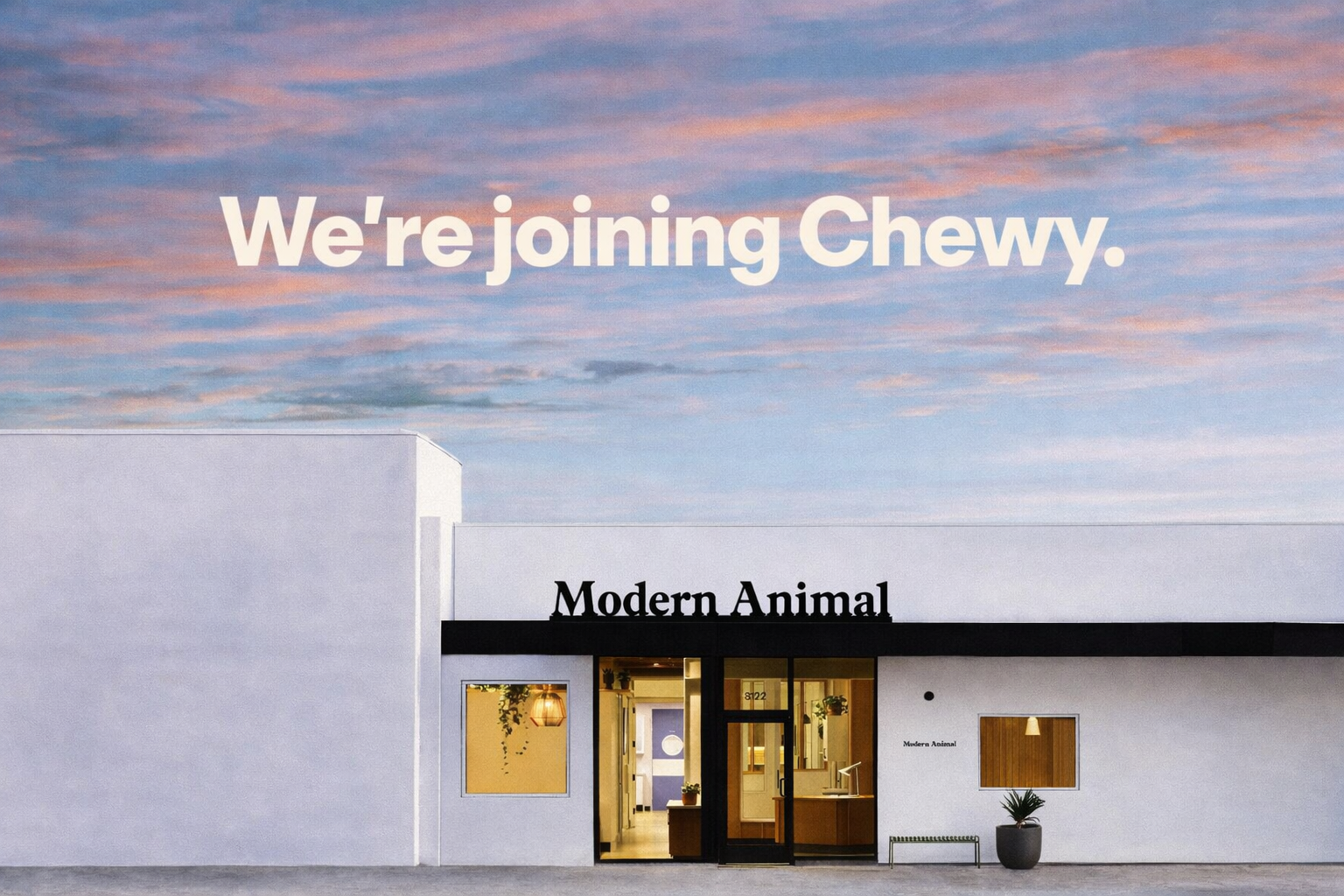
This morning, Chewy announced it will acquire Modern Animal, a 29-clinic veterinary group with 100,000+ member families and $125 million in annualized revenue. Chewy’s veterinary footprint jumps from 18 locations to 47 overnight.
The veterinary profession’s reaction was immediate and justified: alarm, frustration, calls to support independently owned practices. I get it. But before we go there, let me tell you where I’m coming from.
I’m a pet owner first. Before I got into vet med three years ago, I had never worked in a practice. But I’m the kind of client who says yes to the dental, yes to the bloodwork, yes to the MRI. I’m picky about who my vet is, I value their expertise, and I follow through on their recommendations. I’m also the COO of Digital Empathy, where we work with over 600 independent veterinary practices. So I see this from both sides: as a pet owner whose behavior Chewy is absolutely building for, and as someone who spends every day helping independent practices compete.
Last month, I was setting up Digital Empathy’s booth at VMX and realized I needed an adapter cable for our setup. Kneeling on the carpeted floor of the convention center, I pulled out my phone, ordered it on Amazon, and it was delivered to my hotel in two hours. I didn’t compare prices. I didn’t check if there was a local electronics store nearby. I just needed the problem solved, and Amazon solved it fastest.
This story represents the most appropriate framing for what’s happening in veterinary medicine right now. A growing number of pet owners think about pet care the same way I thought about that cable. They’re not evaluating you against Chewy on medical quality. They’re evaluating you on how easy it is to schedule an appointment, refill a prescription, and get a question answered at 9pm on a Tuesday.
I can hear the thoughts forming in your head: medicine is not about convenience, it’s inherently different. Yes, it is. But the decision about where to access that medicine is increasingly made on convenience. The quality of your care gets you the second visit. The ease of your experience gets you the first one.
I’m going to walk through the business side first: what Chewy actually built, how they telegraphed it, and why this acquisition is different from anything the industry has seen before. Then I’m going to get into what it means for your practice, things to think about, and what you can actually do next.
Spoiler: this is a very long read, so grab a cup of coffee (or, if you’re like me, a sugar free Red Bull) and settle in.
This Is Not the Typical “Corporate” Playbook
When Mars acquired VCA, when NVA rolled up hundreds of general practices, when private equity firms went on buying sprees, the threat was direct: sell or get squeezed. Corporate consolidators wanted your clinic, your staff, your client list. They bought existing practices and installed corporate management to optimize and streamline.
Chewy is running a completely different strategy because they’re not acquiring independent practices. They’re building from scratch, in urban markets, with a consumer-first model designed to make pet owners choose them—not because your medicine is worse, but because their experience is easier.
This is not “sell or die” pressure. It’s “modernize or get left behind” pressure. And the response to each is very different.
This Was Telegraphed for Four Years
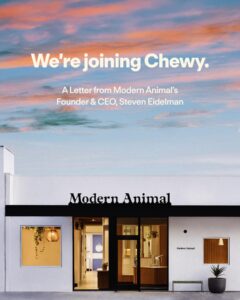
Modern Animal’s Instagram announcement
Today’s acquisition feels sudden, but it wasn’t. Ryan Leech of The Birdbath preaches the (very smart) advice to read companies’ filings because that’s where you find the good stuff. He’s absolutely right. I know, because I went through four years of Chewy’s quarterly earnings calls and investor presentations, and they laid out this entire strategy in public filings, quarter by quarter, in plain language to investors.
- 2020-2021: Laying the groundwork. Chewy launched Connect with a Vet telehealth and Practice Hub, a B2B marketplace that onboarded over 1,000 veterinary practices onto Chewy’s platform. They framed it as partnership: “We are excited to partner directly with veterinarians to improve the customer experience while simultaneously helping to grow revenues for their clinics.” Meanwhile, they were learning how veterinary practices operate from the inside.
- Late 2022: The infrastructure play. Chewy acquired PetaByte for $43.3 million. PetaByte built Rhapsody, a cloud-based practice management platform. They bought the software to run veterinary clinics a full year before they announced they were opening any practices. CEO Sumit Singh told analysts to think about the health business in “three-year increments,” using Chewy Pharmacy’s trajectory (zero to #1 in the U.S. in four years) as the template.
- December 2023: The watershed moment. At their Investor Day, Chewy announced Chewy Vet Care, their own veterinary clinics. They claimed an addressable market of $47 billion. Mita Malhotra, President of Chewy Health, told investors: “We are leveraging all the B2C and B2B pet health and wellness offerings that Chewy has spent years building and bundling them for use within our own ecosystem.” They called it an “open to all ecosystem,” language designed to make vets feel like partners…for now.
- 2024: Proving the model. Chewy opened 8 clinics across Florida, Georgia, and Colorado. Every quarter, Singh reported they were “exceeding expectations.” By mid-2024, the language shifted: clinics were an “acquisition funnel” and an “ecosystem flywheel.” More than half of new clinic customers went on to shop at Chewy.com within 30 days.
- 2025: Full conviction. Singh stopped saying “building” and started saying “owning”: “There are multiple benefits of owning this ecosystem.” He called Chewy Vet Care clinics “highly defensible moats.” By the end of fiscal 2025, health represented 30% of the company’s total revenue. He called the vet clinic business “the fastest NSPAC compounder in the business,” meaning clinic customers spend more, faster, than any other customer type Chewy has.
- April 8, 2026. The Modern Animal Acquisition. Singh’s language: “the preeminent end-to-end pet health ecosystem.” 18 locations became 47. And analysts flagged his use of “owned and asset-light models” as a signal that licensing or franchising the Rhapsody platform to other practices may come next.
The pattern: buy the software, build the relationships, launch the clinics, prove the economics, acquire at scale. Every step was public. The $40 billion veterinary services market is Chewy’s stated target, repeated across multiple quarters of public filings. They laid out their strategy and documented the results in real time.
The Ecosystem Nobody Else Has Built
Industry observers have compared this to Amazon acquiring Whole Foods, and the analogy is useful. Amazon didn’t buy Whole Foods to run grocery stores. They bought it for the physical footprint, the customer data, and the distribution points to plug into their existing ecosystem.
Here’s what Chewy has now assembled:
- America’s #1 online pet pharmacy
- CarePlus pet insurance and wellness plans
- Connect with a Vet telehealth platform
- Rhapsody, a cloud-based practice management platform
- 47 owned veterinary clinics
- Modern Animal’s 24/7 virtual care app and 100,000+ enrolled member families
- A 21-million-customer base with deep Autoship loyalty (recurring revenue)
No one else in veterinary medicine has anything close to this. Mars has 3,000 hospitals but no consumer commerce layer. Private equity buys practices but don’t own the client relationship outside the clinic walls. Chewy owns the relationship everywhere: the food bowl, the pharmacy, the insurance plan, the appointment, the follow-up, the refill. One ecosystem, built upon one login. They authorized a $500 million share buyback the same day they announced the acquisition.
(For non-stock market people, like me: A share buyback means the company is spending its own cash to buy back its own stock from the market. It signals to Wall Street: “We’re so confident in our future that we’d rather invest in ourselves than hold the cash.” Doing it the same day as the acquisition announcement is basically Chewy saying “this deal makes us stronger and we’re putting our money where our mouth is.”)
The Sentiment Gap
Within hours of the announcement, veterinary social media lit up. Veterinarians posted about boycotts and corporate greed. Dr. Molly’s Instagram reel reaction to the news racked up thousands of likes with the message: support your locally owned practices. In the same comment sections, pet owners were asking how to find Modern Animal locations near them.
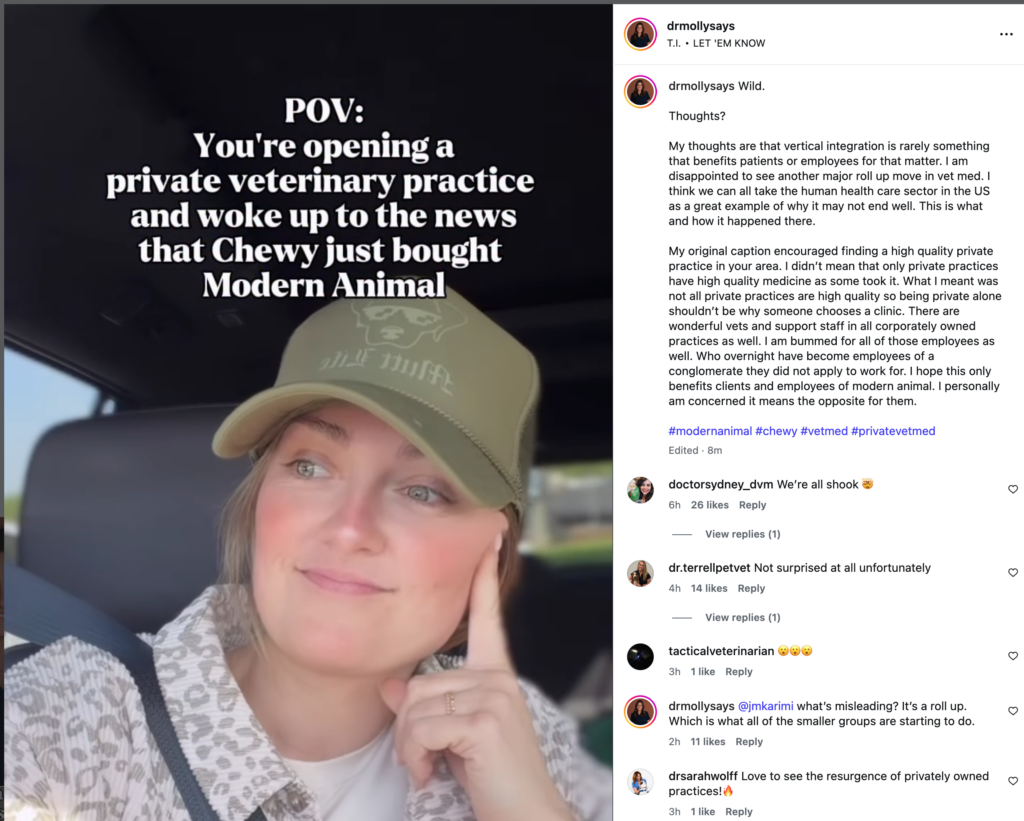
Dr. Molly’s Instagram Reel reacting to the acquisition news.
One comment from (presumably) a pet owner stood out: “How does one figure out which vet practices are locally owned? Websites aren’t always particularly straightforward.” That’s a pet owner who wants to support independent practices and literally can’t figure out which ones are independent from looking at their websites.
The veterinary profession has a complicated, often contentious relationship with Chewy, and much of it is warranted. I’ve read (many) firsthand accounts about lost pharmacy revenue, aggressive tactics, and a company that positioned itself as a partner while building competing infrastructure. I’m not going to share an opinion there as someone who hasn’t been directly affected. What I can offer is the pet owner perspective, because that’s where much of my thinking comes from.
Many, many pet owners see Chewy as the company that delivers their dog food on autopilot, sends a handwritten card when their pet passes away, and has customer service that is responsive and disarmingly helpful. They experience Chewy as convenience, reliability, and a brand that genuinely seems to care about their pets—and by extension, them.
One of the most thoughtful responses on Dr. Molly’s instagram post came from a veterinary technician who has worked at Modern Animal: “I understand all the frustration about corporate vet med, I do, but blanket bashing of corporate practices only hurts those who work there and are doing their best, because it gives pet owners permission to villainize us for everything we do.” I agree. The conversation the profession is having about this acquisition is, in some cases, pushing pet owners away from veterinary professionals of all kinds.
What Chewy Gets Right
If you want to grow your independent practice, if you want pet owners to find you and choose you and keep coming back, you need to understand what Chewy is doing right. That doesn’t mean becoming them, but it does mean paying attention.
Pricing transparency. Both Chewy and Modern Animal publish pricing openly, because this is a baseline consumer expectation both companies understood early. At Digital Empathy, we work with over 600 independent veterinary practices, and we’ve been studying this. Across 13 DE practice websites and more than 130,000 sessions over a 90-day period, visitors who viewed a pricing page converted at 2.6 times the rate of those who didn’t. Pet owners want to know what things cost before they walk in the door. The practices that make that easy are converting more of the traffic they’re already getting.
Digital-first access. Modern Animal’s entire model runs through an app: booking, communication, records, virtual follow-ups. You don’t need to build an app. But you do need online booking, a mobile-friendly website, and a way for clients to reach you that doesn’t require a phone call during business hours.
Membership stickiness. Modern Animal’s 100,000+ member families represent recurring revenue and reduced price sensitivity. Wellness plans aren’t new to independent practice, but adoption remains low. Chewy is betting its entire veterinary strategy on this model. That tells you something about where consumer expectations are headed.
Relentless convenience. The bar for convenience isn’t being set by other veterinary practices, but rather by every other service in your clients’ lives: the grocery delivery that arrives in an hour, the pharmacy that texts when the refill is ready, the doctor’s office that lets you book at midnight from your phone. Pet owners don’t compare your booking experience to the practice down the street—they compare it to everything else they interact with in a day. That’s the gap Chewy is building into.
What Chewy Can’t Replicate (and What They’re Trying To)
If you’ve been on social media, you already know this: Chewy understands emotional connection, and they’re extremely good at it. The flowers they send when a pet passes away. The handwritten cards. The customer who accidentally receives an auto-shipped bag of food after their dog dies, and Chewy tells them to donate it to a local shelter while refunding the charge. They’ve expanded into sending painted rocks as memorials, baby bibs when customers have new children. Their stated mission is caring for the pet and the whole family. These moments go viral because people love this level of surprise and delight.
When I say Chewy can’t replicate what independent practices have, I don’t mean they can’t do emotion. I mean they can’t do yours.
One of our Digital Empathy clients, Animal Hospital Southwest in Fort Worth, has been independently owned since 1975. Dr. Michael Morris founded it because he believed southwest Fort Worth was underserved. Fifty years later, he’s still there. The practice offers care in English, Spanish, and Portuguese because that’s who lives in their neighborhood. They partner with a local rescue that takes on second-chance animals, the ones municipal shelters can’t place. Their about page reads like a letter from someone who has spent half a century in the same zip code and plans to spend the next fifty years there too.
That story is not replicable by a publicly traded company. It just isn’t. Today, I was on a call with one of our DE customers: a very rural independent practice here in Texas. They brought up Animal Hospital Southwest’s “about” page, and said it captured exactly why they got into this work. We made plans about how to tell their own story about their practice.
The emotional connection that makes people choose you, and keep choosing you, is real. Chewy can gesture at it from a corporate office, but you, as an independent practice, can live it. But you have to actually tell the story—most practice websites don’t. Most about pages are a list of credentials and a stock photo of a stethoscope. The practices that invest in telling their human story, who they are, why they’re here, what they stand for, are giving pet owners a reason to choose them that has nothing to do with convenience and everything to do with trust.
Those advantages only hold if the pet owner’s digital experience doesn’t actively work against them. Independent veterinary medicine can be excellent. But if a pet parent can’t find your hours on your website, can’t book online, can’t figure out what you charge for an emergency exam when their dog is vomiting, that excellence never gets a chance to matter. The relationship can’t start if the front door is closed.
Four Things to Do This Week As an Independent Veterinary Practice
Okay, I promise I’m almost done. I’ve spent a lot of this post on what Chewy is doing and why it matters, and I appreciate you sticking with me. But the question you’re probably asking is: what do I actually do about this? Here are four things you can act on this week.
Audit your digital front door. Pull up your website on your phone right now. Can you find the phone number in under three seconds? Can you book an appointment without calling? Are your hours, services, and pricing clearly listed? If a pet parent found your site and Chewy Vet Care’s side by side, which one would make them feel more confident? Be honest.
Create a pricing page if you don’t have one. It doesn’t need to be perfect. Even a page with estimated ranges for your most common services (wellness exams, vaccines, dentals) gives pet owners what they’re looking for. Our internal data shows pet owners convert into booking at appointment at 2.6x the rate of those who don’t see pricing.
Ask your front desk how clients reach you after hours. If the answer is “they can’t” or “they leave a voicemail,” that’s a gap. Look into whether your practice management software has a client communication feature you’re not using, or explore a simple texting tool. The goal isn’t to be available 24/7. It’s to make sure a pet owner with a question at 8pm doesn’t Google their way to someone else. There are so many tools that make this easier than ever before.
Get clear on who you serve and why. Chewy built their entire model around the urban pet parent who wants always-on, app-first convenience. That’s a specific consumer with a very broad appeal, but it’s not every consumer. If you’re a rural practice, a feline-only clinic, an integrative medicine hospital, or a mixed practice doing large and small animal, you’re serving someone Chewy isn’t even thinking about. The clearer you are about who your practice is for and what makes you different, the harder it is for anyone to compete with you on it.
Where This Leaves You
Unlike other consolidators, Chewy isn’t trying to buy your practice. They’re building something next door that’s easier, more connected, and more transparent. They told us they were going to do it, and today they accelerated the timeline.
The good news: none of what makes them compelling is out of reach for an independent practice. Transparent pricing. Online booking. A website that works on a phone. Wellness plans. Accessible communication. These aren’t billion-dollar investments. They’re decisions any practice owner can make this year.
The practices that treat this as a wake-up call, not a death sentence, are the ones that will hold their clients and hold their ground. The answer has never been to out-spend the corporations. It’s to out-care them, and make sure your clients can actually see that you do.
By Alie Cline, COO at Digital Empathy. This post was written with AI assistance.


Leave A Comment